
This podcast was recorded in Spanish. Below is the English translation of the podcast.
Episode 10: “Anthropocene Subsistence: The Embodied Inequalities of Global Food Systems. Part 1: Political, Legal and Epistemic Disputes”
00:00:00 Juan Mayorga: Embodied inequalities of the Anthropocene, building capacities in Medical Anthropology, a series that analyses the effects on human and non-human well-being in this geological era of profound transformations.
00:00:21 Laura Montesi: In December 2020, Mexican President Andrés Manuel López Obrador published a decree in the Official Gazette of the Federation aimed at gradually replacing the herbicide known as glyphosate in crops in order to protect health and the environment. In early 2023, another decree banned the release of genetically modified corn seeds into the environment, as well as the use of this type of corn in grains intended for nixtamalisation or flour production in the sector known as dough and tortillas for human consumption. The use of genetically modified corn was permitted for the rest of the human food industry and for animal feed. Directives were also established to gradually replace genetically modified corn in the feed and industrial use sectors for human consumption, with a view to extending biosafety and achieving food self-sufficiency through national production. The United States expressed its disagreement with these initiatives, seeing them as a threat to its corn exports to Mexico. For Mexico’s northern neighbour, these measures are incompatible with Mexico’s obligations under the Free Trade Agreement between Mexico, the United States and Canada, known as T-MEC, which came into force on 1 July 2020.
The controversy led to the establishment of a panel of experts as provided for in the legal provisions of the USMCA. In December 2024, after reviewing the various positions, the panel issued its ruling in favour of the United States and Canada, arguing that the Mexican measures are incompatible with certain provisions of the USMCA, that they are not based on relevant scientific principles, and that in the context of the dispute, Mexico did not provide a risk assessment in accordance with the standards, guidelines and recommendations of relevant international organisations.
Taking this dispute as an opportunity to reflect on issues concerning food security and sovereignty, the possible conflicts between trade law on the one hand, and the right to life, healthy food and a healthy environment on the other, we decided to interview experts who, from their disciplinary, scientific and community activism fields, have closely followed the issue of the protection of native corn in Mexico, a country considered to be the centre of origin of Zea mays and whose diets, cultures and ancient civilisations have developed around this grain.
My name is Laura Montesi Altamirano. I am a medical and health anthropologist and researcher at the Secretariat of Science and Humanities attached to CIESAS Pacífico Sur, and we welcome you to a podcast session focused on these issues.
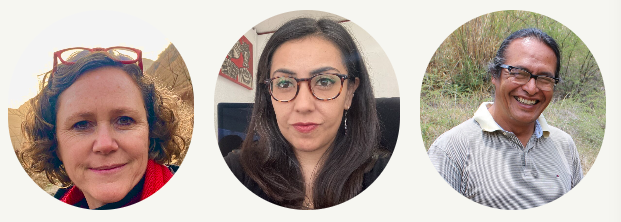
On this occasion, I am pleased to share this talk with colleagues, whom I am delighted to introduce. First, we are joined by Dr Ana Wegier Briuolo, a researcher at UNAM, specialising in Conservation Genetics and Agrobiodiversity. Ana studies wild and domesticated species such as cotton and maize, integrating political science and society for the conservation of biodiversity. Passionate about scientific dissemination, Dr Wegier works actively on issues of agrobiodiversity , conservation, evolution and public policy. She participates in national and international commissions related to sustainability, conservation, and biosafety, and served as an expert witness on the USMCA panel on Mexican measures regarding genetically modified corn in matters of gene flow and biodiversity. Thank you, Ana, for being here with us today. Thank you very much.
Joining Ana in this episode is Polette Rivero Villaverde. Hello, Polette. Thank you very much, and it’s a pleasure to have you all here. Very well, Polette is a full-time lecturer at the Centre for International Relations of the Faculty of Political and Social Sciences at UNAM and is currently a doctoral student in the Latin American Studies postgraduate programme. She has collaborated on various research projects and has published articles on Latin American geopolitics and geoeconomics, economic crisis, civilisational crisis, as well as food security and sovereignty and the role of food in wars, a topic that I find very timely at the moment, and financialisation. In her professional experience, she worked in 2019 as Deputy Director of International Policy and Regulations at the Inter-Secretarial Commission on Biosafety of Genetically Modified Organisms, formerly known as CONACYT and now SECIHTI, the Secretariat of Science, Humanities and Technology. Welcome to this space, Polette.
And finally, I would like to introduce Aldo González Rojas, a Zapotec from Guelatao de Juárez, Oaxaca, and a member of the indigenous rights department of the Union of Organisations of the Sierra Juárez de Oaxaca, where he has worked to defend the rights of indigenous peoples. Since the 1990s, he has maintained an ongoing campaign for the defence of native Mexican corn and against contamination by genetically modified organisms. He is a member and promoter of the Network in Defence of Corn, and also promotes the right to self-determination of indigenous peoples in Zapotec communities in Oaxaca. He has participated in the Oaxacan Collective in Defence of Territories and, together with his colleagues, is currently organising the summer workshop “Strategies for Community Teaching”. Aldo, welcome, thank you for being with us.
Ana, let’s start with you. Can you explain what genetically modified organisms are, and more specifically, what genetically modified corn is?
00:06:39 Ana Wegier: Genetically modified organisms can be understood as those whose genetic information we have altered to perform a particular function that it did not have before. They are those in which mechanisms or machinery are introduced that will give that crop a completely different function, and that is why it is necessary to tamper with its genetic information, change it, change things around. The principle of genetic modification is that this is altered, but the methods and techniques are very varied. There are those we know as transgenics, which involve inserting information from another species into the crop, but there are also some where the existing genetic information is changed to one that fulfils the functions. This is done more in terms of medicine, on an individual basis. So we have to divide what is crops, what is medicine, what is research in general, what we are referring to all the time is the genetically modified organisms that we are going to eat.
Genetically modified corn is corn that has been artificially modified in a laboratory to behave differently from how corn and its wild relatives have behaved for thousands of years. What do I mean by this? a piece of genetic information from a bacterium is inserted, and for that genetic information to work, a small piece is also added at the beginning and another at the end from other species, and a marker is also added so that we know that the information is there. So, a little train of four species is made and introduced into the maize, and then, within the genetic information of the maize, we can imagine it as a long, long, long train that makes the maize all the ways it is. that is its genetic information, it says more or less how it will be, but now a little piece is added that has the capacity to make the maize do new things in that carriage, let’s say, such as producing proteins that are insecticides.
Now the insects that eat the maize, those insects are going to die. That was a capacity that the bacteria had, from which they took the genetic information, and that information is now inserted into the maize, and the maize then changes because its relationship with the environment changes. Before, corn was, let’s say, friendly to these insects that could eat it, and now it is no longer so, but that changes all the relationships in the system, in the cornfield, in the crop, they change because these insects were also eaten by birds. So, if they are no longer there, many other relationships change.
So that’s one example, but there may be others, such as why genetically modified maize can resist glyphosate. Now this herbicide, which is very powerful and kills plants, can be applied, but maize that is genetically modified to survive glyphosate does have this ability, it survives, and why do they survive? Because their metabolism is accelerated, they are on the defensive, and so the way the plant interacts with the environment is completely changed. So, in summary, genetically modified maize has new functions that have never been seen or analysed before in the context of maize, which is why a great deal of research is being done to introduce these new functions that mainly serve only the producers. They have no benefit for consumers, the environment, or anything else; they are only for producing faster and using the agrochemicals that are sold.
Similarly, the same industries that sell the seeds and so the problems of genetically modified corn can be analysed in different phases, no, from those related to the economy, culture, health and safety aspects, and also the dependence they generate. These seeds only work and are made to be sold for one generation, not like our Mexican corn system, where we save and store the seeds. These aspects, as they are not anticipated by those who sell the seeds, are not researched and very little is known about the consequences they have on many generations in the open field interacting with the entire cornfield, all the insects, the bacteria, ourselves eating, saving seeds, cultivating year after year. All these aspects of genetically modified corn in general are not researched.
Something very important that we need to learn is that genetically modified maize only refers to the mechanism or techniques of modern biotechnology used to insert genetic information into maize. But genetically modified maize is many things because it depends on what, how and when you want that maize; the maize will behave differently. What do I mean by that? I mean that maize with insecticidal properties is not the same as maize that is resistant to herbicides, or maize that can carry vaccines or be used to produce plastics or fabrics. It depends on what I want to do, it is for the modification that was made, and then we know that each piece of information, the genetic information that is there, is not alone; it depends on the environment it is in and how it behaves.
So, in the same way that we react to the environment, if it is cold, if it is hot, different things happen to us, we feel cold or we feel hot or we get sick or we don’t get sick. Well, the same thing happens to plants. Genetically, we may have the information inside, but what happens in the environment changes how they behave. So it is very important that, although we often talk about genetically modified corn as one thing and generalise, we have to learn that if a genetically modified corn has already tried one thing, it is not enough, each one of them has to keep trying and proving what they are.
00:14:19 Laura: Ana, thank you very much. I think you’ve given us a lot of insight to help us organise our ideas, and I find it particularly fascinating to think of maize not as an isolated entity, but as a living entity that is part of a larger, more complex system. And so we have to think in terms of relationships. I think that’s extremely important, and it’s an element that is often lost when debates become very dichotomous, very binary, about whether GM maize is good or bad.
And in particular, you mentioned, for example, the concept of the Mexican maize system. So I would like to ask you if you could explain what you mean by the Mexican maize system, and you also told us that with genetically modified maize we are replacing maize that has developed and evolved over thousands of years and that we can be sure is healthy and safe. So why is the principle of safety crucial for the population’s food and health? What do you understand by safe for health?
00:15:34 Ana: Starting with what the Mexican maize system is, maize has wild relatives in Mexico, and there are also native varieties that we call maize races. There are also hybrid maize varieties and improved maize varieties. All these corn varieties have their own characteristics, but they are of the same species. Their genetic information is arranged differently, but it is basically the same because they can all reproduce with each other, and no new information would appear in these crosses. So it is the genetic information of corn that comes through thousands and millions of years of evolution, because it is from the wild relatives, which are all the teocintles, the races. We know that there are 59 races, but that is just a way of classifying corn. The diversity within these races is enormous, and there are races that are sown from the Yucatan Peninsula to Veracruz and then Tamaulipas, and their genetic information varies greatly, but they are still part of the same race because they have the same characteristics that we see. But inside, genetics shows us that they are also diverse internally. That is a fundamental characteristic of corn varieties. Hybrid corn also has its own characteristics, but these are not diverse. They require much more attention in crossbreeding in order to produce seeds, and when farmers grow these seeds, they generally cannot save them for the next generation because they produce much lower yields.
There are also other types of maize that we call acriollados, which are improved or hybrid maize varieties that have been gradually adapted by people and whose characteristics are now more mixed and more manageable. All of this is maize whose genetic information has not been altered in laboratories. It is what is known as traditional improvement, but it can be done at an INIFAP or UNAM centre, or it is the improvement that farmers are doing all the time as they select and experiment. There is a great deal of experimentation by farmers that is generating new characteristics in maize. All of this is the Mexican maize system. What is not included in Mexican maize, then, is genetically modified maize, which has been banned from cultivation in Mexico since 2013 by court order. But it is also now banned by the Mexican Constitution, which states that maize that has been genetically modified by techniques that overcome the barriers of reproduction and recombination cannot be cultivated. This simply means that all corn that can reproduce with each other and whose diversity was not obtained through laboratory techniques, as I explained is the case with genetically modified corn, is permitted. What is not permitted, and therefore not included in Mexican corn, is changing its identity and integrity.
And now you asked me about safety, right? So, moving on to the next question, what do we mean by safety? I think we can frame this question in terms of the guarantees that Mexican corn gives us. We have the guarantee, for example, that I can recommend eating maize to a person or an infant, to minors, to boys and girls. They can eat almost as much maize as they want, and I know that they will not get sick, that they will not be poisoned by the amount of maize they eat in general, that they will not have a major health problem. I have that guarantee, and that guarantee is a certainty that I have because for so many years we have known generations of people who have eaten maize in its different forms, from when they are babies in atole, from childhood, in all forms and in tortillas, while we are adults, maize does not harm older adults, we know that this is a guarantee of safety. Why do I put it that way? Because it could be that genetically modified corn has to be tested to see if it can really be eaten 365 days a year, three times a day, at all stages of our development, that is, from when we are babies until we are elderly. All of this is very important to test because the amount of maize we eat in Mexico is not the same as in any other country in the world, and therefore this is what we need to know: whether it is safe or not. We know that our maize, again, all varieties of maize and even hybrids, can be eaten, but what we do not know is whether this maize, which is now genetically modified, may be different, may have different properties. So, the one that has been injected with an insecticide protein has to be tested, but the one that has been injected with the property of resisting glyphosate also has to be tested. And if tomorrow they invent a corn that does something else, then they have to test that too. That is what we understand by safety.
The other guarantees that maize gives us are that we know we can exchange it and we are not harming those with whom we are exchanging it, it is not an illegal commodity, we know that we can pass it on and that passing on seeds does not mean passing on problems. So we pass it on willingly, no, with all that that means. We need to take care of these different guarantees because genetically modified maize means the loss of these guarantees. Genetically modified maize, for example, in terms of being protected, if I give it to someone else, they may have problems later on if they want to sell it, profit from it, if it has intellectual property rights belonging to an international company and they want to export it, do something else with it, they cannot, because there are rules that will no longer allow it. Or if I have genetically modified maize and I want to plant it at home, I cannot guarantee to all my neighbours that I will not genetically contaminate them with it, because biologically, maize always reproduces with those around it.
So genetically modified corn does not have the same guarantees for health, the environment, or cultural or economic perfection. I think it is very clear to us why the principle of safety should be at the centre of Mexican policy, within its domestic policies. But it must also be transferred to the international level with all these discussions and legal disputes that have taken place. Ultimately, the safety of genetically modified maize must be proven, and not the other way around. So I think it can be a guiding principle.
00:23:58 Laura: Thank you very much, Ana, for your contributions. They give us a very complex yet clear picture…
Polette, we’ll continue with you. Could you give us a broad overview of the current situation regarding Mexican government policy and the national food system? When we talk about promoting native maize and controlling the use of genetically modified maize, what is really at stake? And from your point of view, why is it so important?
00:24:29 Polette Rivero: Hello, it is a pleasure to share with these distinguished colleagues. First, I would like to emphasise the importance of referring to the previous context when discussing current food policy. we must refer to the previous context and, in that sense, very briefly recount, or rather, remind ourselves that 35 years ago, we were dominated by what we know as neoliberal policies, which are important because they led to the dismantling of food sovereignty and self-sufficiency in our country. Let us remember that this dismantling took place mainly through the counter-reforms to Article 27 of the Constitution, the new agrarian era, the decree ending agrarian distribution and, above all, the signing of the Free Trade Agreement with the United States and Canada. This treaty opened the doors to highly subsidised agricultural products, which resulted in the exclusion of peasant production, because it allowed the entry of extremely cheap products that displaced the peasants who were the ones who sustained food self-sufficiency and sovereignty. This treaty also brought about the gradual introduction of genetically modified organisms, particularly yellow corn, and increased the power of large grain, seed and cereal trading companies, particularly those in the United States, as never before.
Well, in that context, we then went on to think about what policies characterise the 4T in terms of agri-food, and it must be said that we continue to be a country that is highly dependent on food imports; that is an issue that has not been overcome. However, it should also be noted that corn, in particular, is a sensitive issue because of its centrality in our diet, our culture and our nutrition, and we start from there to consider whether there have been real changes in the agri-food policy of these 4T governments and what those changes consist of. From my point of view, in the previous six-year term and in the current one, there have been significant, albeit insufficient, changes to structurally dismantle the inequality gap between those who, on the one hand, exercise agri-food dominance and, on the other, those who have been thrown into welfare policies for survival, namely small farmers.
On the first point, I want to emphasise that I do believe there have been significant changes because I want to acknowledge that, contrary to the previous policy that favoured the purchase of food from abroad in the 4T development plans, a new public production policy has been considered, which in this case is called welfare, or so they have called it. This is important because it has turned its attention back to small producers, giving rise to subsidy programmes, fertilisers, and a still inefficient but important plan, for example, for guaranteed prices. And then we have livestock credit on trust, the replacement of the ASERCA programme by the parastatal SEGALMEX. Of course, there is the well-known Sembrando Vida programme, which is aimed at different rural communities. However, it must be said that although all these programmes mark a change of direction, they have been insufficient to re-establish our country’s food sovereignty.
Currently, Dr Sheinbaum’s programme, which she has called Sembrando Soberanía (Sowing Sovereignty) for the second stage of the fourth transformation, is being criticised. Its goal is to achieve food self-sufficiency in maize, beans, rice and other products by 2030, but the discussion about its scope has been important. So, with this, I would say that it has been insufficient. I think that the previous model has not been completely reversed and that today we are still dependent on the purchase of important grains such as corn, wheat, sorghum, beans and soybeans, and there are many programmes that still do not reach small producers. In this regard, I believe it is essential to criticise the fact that the 4T needs to rethink, in a much broader sense, how to better link peopl , the national economy, self-sufficiency, and food sovereignty, taking into account the issue of climate and environmental change. In other words, it is complex, progress has been made, we must recognise that. However, there is still much, much to be done, and in that sense, that is why the voice of farmers is so important.
00:29:43 Laura: Thank you very much, Polette. I think you have given us a very broad overview and, above all, you are telling us that we need to take a long-term view and understand history, particularly the agricultural history of Mexico. And everything that this has meant for peasant production, just for those who may not be so familiar with the Mexican context, to explain that when we talk about 4T, this is a name that López Obrador’s government gave itself, referring to the fourth transformation after the historic social transformations that took place in the country. And well, those who held power in the last six-year term and in the current one consider that their policy represents a great transformation from the bottom up in the country, and this has become part of the everyday language of the Mexican population and also ours. Thank you very much, Polette.
I think this emphasis on small producers, as opposed to large industries and large food companies that are already part of our food landscape, is very important, isn’t it?
So, with this new policy, with its successes but also its limitations, which you were beginning to present to us, it is clear that Mexico, in the previous six-year term and in the present one, has been issuing decrees and has carried out a constitutional reform with a view to protecting what we might call the Mexican maize system, remembering that Mexico is recognised as the centre of origin and that we obviously have enormous biogenetic and cultural diversity in relation to this staple grain in our diet. How important are these actions in terms of reforms and decrees? And on the other hand, what are the limitations of working at the level of constitutional reforms? And from your point of view, what concrete steps should be taken to protect the Mexican corn system and food sovereignty?
00:32:03 Polette Rivero: I really like your question because it is connected to the previous one, and the first thing I would like to say here is that, in reality, the struggles of the farmers in our country are historic and that, in fact, if we can talk today about that great diverse system that is the milpa, it is precisely because they have been its historical caretakers. Therefore, we cannot think of any of thes s in the political regulatory changes that have taken place in the countryside without the sustained historical struggle of these people, which is precisely the result of this historical demand, joined by civil organisations and even academia with a much more critical approach. I believe that all these legal reforms have been fundamental because they recognise the importance of defending our maize, especially after the neoliberal period I mentioned earlier, which brought with it the introduction of genetically modified organisms. The legal field is just one of the other areas where we must fight to defend our corn, our food, our health, and even our lives. In this sense, I believe that the legal field is also a battle for the legal narrative, and what we see is that, although the law is not everything, the norm is not everything, it is used on both sides, whether to defend commercial rights or human rights, the rights of life, and that is why they are so important.
If we were to briefly recount all the political and legal actions that have been taken to defend this country, I think we would have to acknowledge, for example, that in 2020 a presidential decree was published for the gradual elimination of glyphosate and the prohibition of the consumption of genetically modified corn, with a view to this happening by 2024. And here, the analysis must go beyond the legal aspect, the pressure exerted by large US corporations and the US government itself within the framework of the USMCA, which led the government of Andrés Manuel to allow, shall we say, a new decree on glyphosate that relaxed the deadlines for that ban in 2023. From there, we can even skip ahead, can’t we? to this legal battle. We see that this participation in the USMCA dispute panel on the ban on genetically modified corn has been a way of thinking that we have a government that, for many, many farmers, including us who are consumers, who are not necessarily directly involved in working the land, represents us as a government that is capable of standing up in a panel to defend the rights that we are demanding. And well, we know that this panel was lost, as Laura also reported on this process.
However, there is another important struggle, which is how to elevate certain other rights related to food to constitutional status, and more recently, with the ban on the planting of genetically modified organisms in maize. Of course, I believe that all these series of reforms and laws are essential to understanding this area of dispute. Well, I don’t want the General Food Law to expire in 2024, and well, we could add to that. So this has shown that there are many, many battlefields, right? However, and I would like to close with this, I believe that the protection of Mexican maize must go through a full substantive recognition of the rights of farmers and communities, because without this recognition we are also allowing this unequal system to continue to be established, which is precisely what prevents us from having healthier food systems and caring for maize. What do I mean by this? I mean that it is the corporate food system that dominates, let’s say, the world, and in that sense it is a dispute in many fields, that is, in the narrative, in the legal, of course, in the economic, and farmers must have their economic rights returned to them in order to then recover all this possibility of being producers of life, not only of maize, not only of milpa, but of life. I think it is a very profound struggle, but it makes us realise that, in the end, in this historical context, we are fighting for the lives of the farmers of our country, and I think the struggle for maize is exemplary for the whole world.
00:37:25 Laura Montesi: Great, thank you very much, Polette. I take away several things from this, including that the law is not everything, but it is very important. And clearly, for it to have force, it needs awareness and popular support. So I would emphasise this last point you made about the substantive recognition of farmers and the need to reconnect the city and the countryside in people’s imaginations and to reconnect consumers and producers as much as possible so that we can demand better food in the midst of a food and health crisis, which is tremendous, not only in Mexico, but particularly in our country. Thank you very much, Polette.
Here we are going to continue with Aldo. Welcome, Aldo. I have a big question for you. These days there is a lot of talk about food sovereignty, but in reality this concept is used in different ways and sometimes even in contradictory ways, it seems to me, or incompatible ways, right? You have been a strong advocate for traditional agriculture and agroecology, and you have been involved in the struggles of peasants and indigenous peoples in defence of native corn.
So, what I want to ask you is what is La Vía Campesina’s definition of ‘food sovereignty’ and why is this concept so relevant t s today? And also, for our listeners, if you could briefly tell us what La Vía Campesina is.
00:38:59 Aldo González: Well, food sovereignty is the right of peoples to nutritious food that is culturally appropriate, accessible to the population, produced in a sustainable and ecological way, and also the right to decide their own food and production system. What does this mean? Currently, governments and international food aid have provided food to populations so that they have something to eat, but it is not necessarily nutritious, safe or culturally appropriate food, right? Let’s say that in Mexico we consume corn and we would like to consume corn that is produced in Mexico, that is produced with native corn varieties, produced using our own traditional production systems in an effective and ecological manner, respectful of nature. We should have the right to decide what corn we are going to consume and that corn should be available on the market. Currently, most of the corn available on the market, produced in Mexico, is produced with agrochemicals, using Green Revolution technologies.
Mexican farmers have little opportunity to produce their own maize because their economies have been undermined over the last 40 years and many farmers have been forced to migrate, so they are producing less and less of their own food. Even so, globally, 70% of the population continues to produce its own food, but the international market, controlled by a few large companies, is trying to take over all food production worldwide and distribute it through supermarkets or other food distribution chains. So, let’s say that food sovereignty is resisting, the principle of food sovereignty is resisting transnational corporations having control over food. Furthermore, having food nearby means that it will not be transported from one continent to another, as is currently the case, which also generates greenhouse gases.
Currently, agriculture, industrial agriculture, generates more greenhouse gases than any other production system worldwide. It generates more than half of the greenhouse gases released into the environment, and that is due to the production of petroleum-based fertilisers, the transport of goods, the amount of fuel used to operate the machines, to generate the energy needed, for water consumption… In short, let’s say that agriculture consumes a lot of energy, and if this food were produced locally, this would be significantly reduced.
The issue of La Vía Campesina. La Vía Campesina is an international organisation that is present on every continent on the planet and brings together more than 300 million farmers from different places. All these farmers produce their own food for local consumption by their families, communities and villages, and are fighting for the rights of farmers to be recognised internationally. There is currently a United Nations Declaration on the Rights of Peasants.
00:43:09 Laura: Well, you’ve touched on many important points, and you were just explaining how these international markets, which are basically homogenising the production, distribution and consumption of staple foods, including maize, have a whole series of repercussions and negative effects, both in cultural and social terms, but also in environmental terms. So, speaking of the market, it seems to me that on more than one occasion, in line with La Vía Campesina, you have publicly argued that agriculture should in fact be kept out of the market.
And so the question is, what does this mean? Is it even possible? What role should traditional and agroecological agriculture play in the national production system in Mexico? And in what sense should policy stop seeing them as relics of the past, something that is going to disappear anyway?
00:44:18 Aldo: Well, I think that, first of all, it is important to be clear about who made the decision to stop supporting agriculture in most countries around the world. This was not done in every country; it was done under pressure from the World Trade Organisation and the World Bank, which forced countries to design public policies that opened up markets and stopped subsidising farmers and the countryside in general. This began to be implemented in Mexico approximately 40 years ago. Many will surely remember CONASUPO, the National Commission for Popular Subsistence, which was responsible, among other things, for regulating the prices of agricultural products. Well, CONASUPO disappeared, the guaranteed prices for agricultural products ( ) disappeared, the national seed producer in Mexico, which was responsible for providing seeds to farmers, disappeared, and DINA, which produced, among other things, some transport and machinery for agricultural use, also disappeared. So let’s say that in Mexico, as in other countries, farmers were no longer subsidised, they were no longer given direct support for production, for example, financing to invest in the countryside. They also took away their ability to obtain insurance for crop losses, among other things. Faced with this situation, the Mexican countryside has been weakening, and there are fewer and fewer farmers in Mexico.
Many farmers, especially in the poorest regions of this country, have been forced to migrate to the United States or to other parts of our country, ceasing to produce their own food. so let’s say that this neoliberal model is what has led to the disappearance of farmers, to farmers becoming labourers in the cities, and to agricultural production beginning to be taken over by transnational corporations. It is said that this model changed so that we could produce food for export, and food for export is indeed being produced in Mexico. Let’s say that the agricultural trade balance is still favourable for our country, but what is being produced? Vegetables are being produced, as are some fruits that require a lot of water for production, while basic foods such as maize, beans and rice, among others, are no longer being produced.
So, let’s say that our country is increasingly dependent on other countries, especially the United States, to be able to have the food that families need, and this situation has left us in a vulnerable position. In addition, environmental regulations, for example, have led to poultry and pig farms migrating to our country because environmental regulations are not as strict here. They were in the United States and were moved to Mexico, and now those animals need to eat, and let’s say that the model with which they have designed those meat production farms is based on feeding them genetically modified organisms. That is why large quantities of genetically modified corn are currently being imported into our country and, apparently, our country is not self-sufficient in corn, but it is because of the corn that has to be imported for meat production.
00:48:17 Laura: Well, that’s very interesting, Aldo, and very frightening at the same time, because these major changes and public policies show us that they ultimately have an impact on our environment, on our food, on the food we put on the table, and this alarm you are sounding, this warning that GMOs are ultimately very present. And if they are not directly present in our food, which we would also have to check with more scientific tests and evidence, we are actually consuming them through meat and this large industry that is ultimately devastating many areas of our country. So, thank you very much for your contributions. We appreciate the work you do together with your colleagues here in Oaxaca, in Mexico and transnationally with La Vía Campesina.
And now we say goodbye again. We are very grateful to Ana, Polette and Aldo for their participation. It has been a privilege to have them here with us. We also thank our colleagues who make these sessions possible and, of course, our listeners for their attention.
We invite you to continue reflecting with us in a second episode that will surely provide more perspectives on the different challenges posed by the Anthropocene and the inequalities embodied in food systems and human and non-human health.
00:49:54 Juan: This episode was recorded virtually between Guelatao, Oaxaca de Juárez and Mexico City. The interview was conducted by Laura Montesi. Production was by Gabriela Martínez and audio editing and post-production by Juan Mayorga.
This podcast is an international collaboration between University College London in London, United Kingdom, the Federal University of Rio Grande do Sul in Porto Alegre, Brazil, and the Centre for Research and Higher Studies in Social Anthropology in Oaxaca, Mexico.
Learning points